
YVY RIDING GUIDES
What Type of Fat-Tire E-Bike Is Best for Recreational Trail Riding?
Choose your terrain. Build your next ride around it.
Explore fat tire e-bikes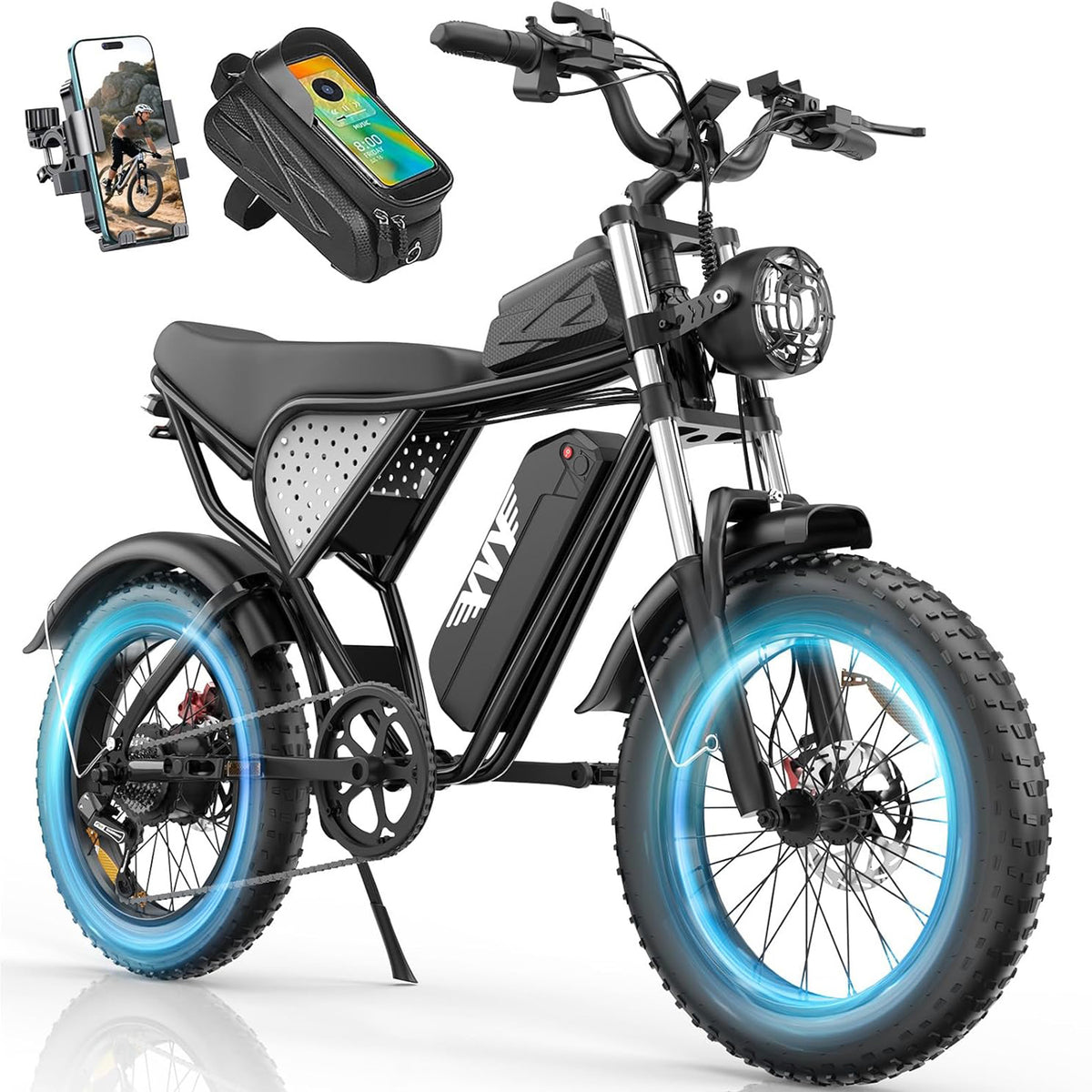
For recreational trail riding—packed gravel, forest roads, smooth park loops, and light mixed surfaces—the better fat-tire e-bike type emphasizes traction, comfort, predictable assist, and brakes you trust at moderate trail speeds. You usually do not need dual motors or dual batteries unless your “recreation” includes very long backcountry mileage. A single-motor fat-tire bike with mid-to-large battery capacity, suspension for chatter, and tires set up for the surface covers most weekend trail fun. Technical mountain-bike singletrack is a different category.
Recreational trail versus aggressive trail
Recreational here means greenway gravel, canal towpaths with packed stone, forest service roads, and rolling hardpack where average riders explore for a few hours. Fat tires (as on YVY’s 20×4.0 and 16×4.0 models) add stability and comfort. Aggressive trail means rock gardens, drops, and steep off-camber roots—terrain that asks for e-MTB geometry, dropper posts, and trail-specific suspension designs beyond typical commuting fat-tire frames.
If your weekends stay recreational, shopping a versatile fat-tire e-bike is rational. If your friends ride black-diamond enduro lines, buy the tool that matches their trails instead of forcing a commute fat-tire bike into the wrong job.
What to prioritize on the spec sheet
Tires and pressure. Width helps; pressure fine-tunes grip. Carry a gauge. Drop modestly on gravel; raise on the paved connector home.
Suspension. Front forks plus a rear shock absorber—listed on several YVY fat-tire product pages—reduce washboard fatigue. They do not replace smart line choice.
Drivetrain. A Shimano 7-speed system (listed on K20-family and K16 pages) lets you keep cadence on rollers so the motor is not dragged at walking-speed stalls.
Brakes. Hydraulics (K20, K20Pro) ease long dusty descents; mechanical discs (K20 Lite, K16) work when maintained but need more hand effort and cable care after grit.
Battery. Two–three hour recreational loops with elevation often fit 48V 20Ah-class packs with assist; 15.6Ah can suffice for shorter park sessions with charging at home afterward. Dual 40Ah-class systems are for riders who stack all-day mileage.
Motor labeling. 1500W-class titles common on these YVY pages are marketing specifications without a clear continuous-versus-peak split in the copy reviewed. Ride trail speeds appropriate to sight lines and other users regardless of the number.
Trail etiquette and access
Confirm whether your park allows Class 1, 2, or 3 e-bikes and whether throttles are restricted. Recreational enjoyment ends quickly with a citation. Yield to horses and hikers as posted, control speed near blind corners, and avoid wet trails that rut easily—fat tires still leave marks when soils are soft.
Comfort details that extend a fun ride
An LCD display helps pace battery use so you are not stranded at the far end of a greenway. LED lights matter if you start late. A small storage box or bag holds a tube and snacks. Recommended height bands on product FAQs (for example K16’s 5.2–6.0 ft language and K20Pro’s 5.4–6.2 ft language) are starting points—standover and reach decide comfort on repeated trail hours.
Type recommendation for recreational trails
- Default recreational type: single-motor 20×4 fat-tire with ~20Ah and preferably hydraulic brakes (K20-style at $649 US as of 2026-10-26).
- Shorter park loops / budget: Lite-style 15.6Ah if you accept mechanical brakes and shorter reserve.
- Compact storage recreational riders: 16×4 type (K16).
- All-day gravel touring recreation: dual-battery type (K20Pro), accepting weight and cost ($1,299 US on the product page, same check date).
Skills session worth doing once
In an empty lot, practice slow-speed balance at low assist, controlled stops on gravelly asphalt, and looking ahead rather than at the front hub. Recreational trail crashes often happen at low speed when a rider overcorrects. A calm first hour prevents many scrapes.
Weather and season
Light rain on packed gravel is manageable with conservative speed and clean brakes afterward. Thunderstorms, flash-flood washes, and muddy spring thaws are good reasons to postpone. Brand IP5-related splash language is not an invitation to ford deep puddles through motor hubs.
Recreational trail riding rewards a fat-tire e-bike type that is comfortable, legal on your paths, and energized for the loop with reserve. Choose mid capacity and trustworthy brakes for most weekend explorers; escalate to dual batteries only when your recreation regularly becomes an all-day range problem.
Group rides and pacing
Recreational trail groups often mix fitness levels. E-bike assist can reduce the gap, but only if you choose modes that do not constantly surge past companions on narrow paths. Agree on stop points. Carry the same repair essentials you would on a solo ride—groups still get flats.
If some riders are on acoustic bikes, remember your closing speed on downhills. Fat-tire stability is not a license to overtake blindly.
Maintenance after dusty weekends
Grit destroys chains and pads faster than city-only commuting. Wipe the chain, check pad surfaces, and clear mud from derailleurs before the next ride. A recreational trail bike that is never cleaned becomes an expensive noise maker by midseason.
Comparing recreational trail bikes to pure commuters
A pure city e-bike with narrow tires may feel faster on perfect asphalt but harsher on the gravel connector that makes your weekend interesting. Recreational trail types accept some pavement inefficiency in exchange for weekend versatility. If 90% of your riding will stay on pristine bike lanes and you rarely touch gravel, a narrower tire e-bike could be more efficient—this article assumes you actually want trail surfaces regularly.
Within fat-tire options, recreational use rarely needs dual motors. Dual motors add cost, weight, and complexity; they help steep loaded climbs more than gentle greenway rollers. Most recreational riders are better served by one robust hub system, sound brakes, and a pack that finishes the loop with 20–30% indicated reserve.
Fitting the ride to fitness goals
Some riders buy e-bikes to eliminate effort; others use low assist to extend how far they can explore while still pedaling. Recreational trail riding supports both, but your battery plan changes. High assist / high throttle tourism empties packs fast on soft surfaces. Low assist fitness-oriented trail rides stretch 15.6–20Ah packs surprisingly far. Be honest about which rider you are before you buy dual batteries “just in case.”
Surface-specific tips
Crushed stone greenways: Medium pressures, steady cadence, watch for washouts after storms. Forest roads: Expect loose gravel in corners; brake before turns, not in them. Hardpack park loops: Watch for walkers and dogs; announce passes. Beach-adjacent packed sand: Float is better at lower pressure, but know when sand becomes too soft to continue.
Bringing it together
The recreational trail fat-tire type is a comfort-and-traction all-rounder: single motor, mid-to-large battery, suspension for chatter, brakes matched to your local descents, and tire pressures you actually adjust. Choose YVY’s K20-style setup when that description fits; step down to Lite or sideways to K16 for budget or compactness; step up to K20Pro only for true all-day range needs.
Explore more in Fat Tires & Trail Riding.
Choose your terrain. Build your next ride around it.
Explore fat tire e-bikes Fat Tires & Trail Riding